hello@mydataremoval.com
 (855) 700-2914


Think about spending hours on starting a business. Then you come to the point of obtaining the necessary permits. But it takes too long. Suddenly, you receive an offer for an expedited approval… Would you take the offer?
The new permit scam involves scammers posing as officials from city permit agencies, tricking victims into providing payment or information. This scam has been reported in the cities of Sanford and Baltimore.
According to ScamWatch, there were over 200,000 reported scam cases in 2025. The top scams were investment scams, phishing, and romance scams. This year, one type of scam that is quietly rising is the permit scam.
Scammers Targeting Permit Applicants

Here’s how the scam works:
- Step 1: Data Collection: Scammers first gather data on their targets, on the agencies they’ll impersonate, and on the people they’ll target. Their sources include public records, social media, the dark web, and people search websites (companies that collect and sell your information). From these, they can get your name, address, contact details, etc.
- Step 2: Impersonation: Once scammers have enough data on the targeted agency, they’ll start the impersonation. This includes creating websites similar to the agency’s and crafting emails, texts, or scripts, emulating how the agency communicates.
- Step 3: Contact: Scammers will start contacting their targets. They’ll promise you an expedited application for a fee. They’re counting on you not knowing official procedures. They also try to manipulate you by offering a seemingly good deal that you can’t resist. And if you’re in a hurry, they’ll put a time limit on the offer to pressure you. But once you hand over money, they’ll just disappear.
That’s how the permit scam usually works. However, there have been variants of this scam, using different tactics.
City of Sanford Warning
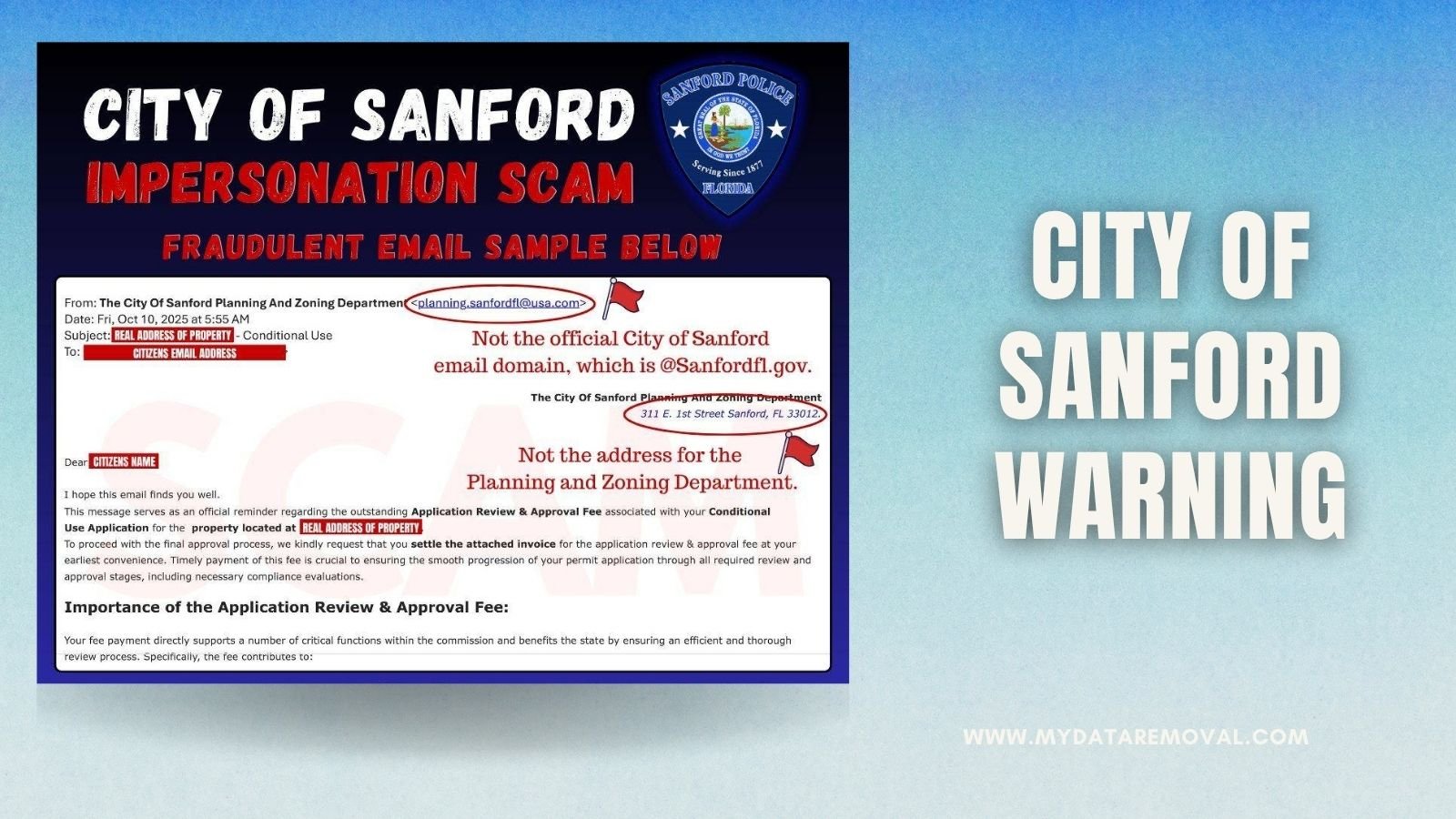
Sanford’s Police Department has issued a warning about a scam targeting business owners in the city.
Basically, scammers pose as employees (using real names of employees) of the City of Sanford Planning and Development office. They send emails with fake invoices to make victims pay for a fee related to a “Conditional Use Application.”
According to the police, the emails have red flags, such as incorrect city addresses and an unofficial address. However, since the emails used real city employee names and the logo of the City of Sanford, they became more believable.
Sanford police remind citizens that the official emails of the city end in “@sanfordfl.gov.” They also recommend contacting the City of Sanford directly (through verified contact details) when you suspect a scam.
City of Baltimore Warning
Residents of Baltimore were also targeted.
According to Baltimore authorities, the emails scammers sent include the victim’s accurate project details, property address, and references to existing planning-commission hearing agendas. Scammers get these pieces of information from public records.
The emails claim that your permit application has been approved. However, you’ll have to pay the fee via wire transfer or through other irreversible payment methods (e.g., gift cards, cryptocurrency, and money transfer services). Plus, some scammers ask for payment for “additional fees.”
One applicant had reported losing about $3,800 after paying for the project’s approval. They were also asked for another $2,800. Additionally, some reported that they’ve been told they can be added to the Planning Commission roster for a fee.
The City of Baltimore said that such offers are fraudulent, reminding citizens that to be added to the Planning Commission roster, you will have to be selected through a public-selection process, not through an email solicitation.
How to Avoid Getting Scammed?

If you’re someone needing a permit, there are easy ways to protect yourself.
- Protection Tip. No. 1: Verify: Before paying anything or providing your information, ensure that you’re sending it to the right people. If you’re unsure about an email or call you received, it’s better to verify it by contacting agencies through official channels (e.g., official city websites or phone numbers).
- Protection Tip. No. 2: Check Payment Methods: Know about the official payment methods by your city’s agencies. If you’re being asked to pay via gift cards, wire transfers, or other unusual methods, refrain from paying. Remember that government agencies don’t use unusual payment methods like these.
- Protection Tip. No. 3: Trust Your Gut: One easy way is to trust your instincts. If you feel that an offer sounds too good to be true, then it probably is. It’s okay to leave the situation as soon as you feel something’s not right.
- Protection Tip. No. 4: Protect Your Data: Scammers can target you because they know your contact details, which they get from data brokers or people search websites. So, you should opt out of these companies. You can do this manually or with the help of a data removal service.
- Protection Tip. No. 5: Be Scam-Savvy: Scammers won’t be able to trick you if you know how they’ll target you. So, you should learn about the ways they might attack you. We highly recommend checking our FREE course on YouTube: “Scam-Savvy: How to Protect Yourself and Spot a Scam.”
What to Do When Victimized?

Now, here are things to do, should you become a victim:
- Step 1: Stop: It can be tempting to reply to the scammers just to get what you’ve lost back, but the scam won’t end as long as you communicate with them. So, it’s best to stop all communication.
- Step 2: Documentation: Take a screenshot of messages, profiles, contact numbers, and emails used. These pieces of information will help authorities build a case against your scammer.
- Step 3: Report: With the evidence you gathered, report the scam to authorities, including your city’s permit office. You can also file a report with the FTC at www.ftc.gov.
- Step 3: Alert Your Bank: Contact your bank or the service you used to send money. Let them know about the scam (you can send them the evidence), and try requesting to reverse the transaction.
Conclusion
All in all, while permit scams are quietly rising, you should be proactive, especially since the impact can be devastating. Be informed, and remember to always verify before handing over your money and information.
Frequently Asked Questions
How can I recover my money from a scammer?
If you’re in the US, you have a chance of recovering your lost money by contacting your bank or card issuer. Let them know about the fraudulent activity and request a transaction reversal.
How do law enforcement catch scammers?
One way law enforcement catches scammers is by obtaining search warrants from a judge. It will authorize them to search and seize pieces of evidence, such as phones, computers, bank records, and other things related to the scam.